

• Home
  • About Us
  • Our Services
    • Cold Calling
    • Lead Generation
    • Virtual Assistants
    • Skiptracing Services
  • Blog
  • FAQ
  • Contact
  • support@vcallers.com
Free Consultation
  • Home
  • About Us
  • Our Services
    • Cold Calling
    • Lead Generation
    • Virtual Assistants
    • Skiptracing Services
  • Blog
  • FAQ
  • Contact
Facebook Linkedin Instagram

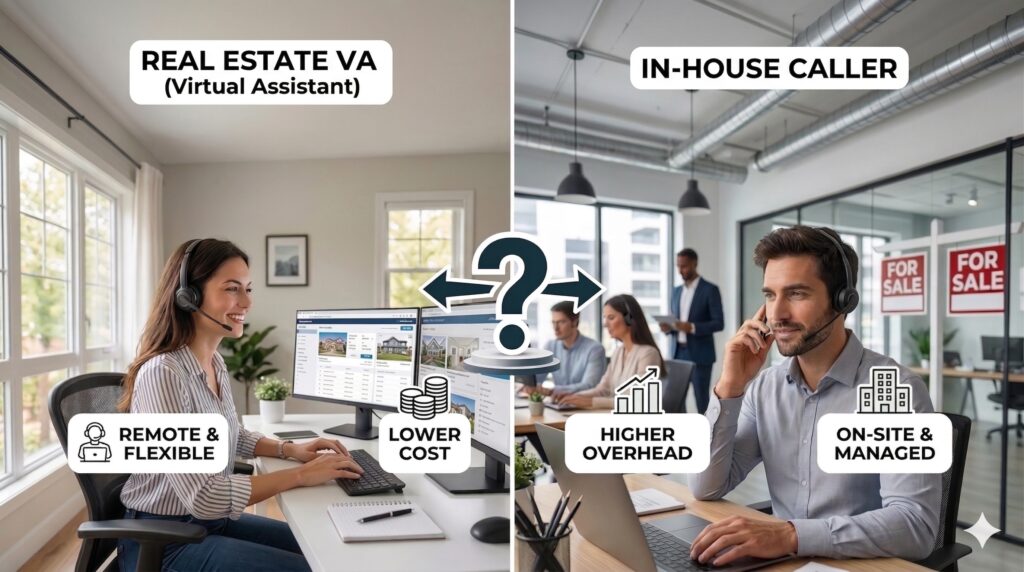
Real Estate VA vs. In-House Caller: Which Is Right for You?

By Velocity Callers 

Scaling a real estate investing business almost always comes down to one bottleneck: lead flow. And lead flow almost always comes down to one activity: outreach. So when you’re ready to stop doing it yourself, you face a critical decision — hire an in-house caller, or use a real estate virtual assistant (VA)?

This isn’t a simple answer. It depends on your volume, budget, management style, and growth goals. In this guide, we break down both options honestly so you can make the right call for your business.

The Case for an In-House Caller

Some investors swear by having a caller in the same room (or city). Here’s why:

Pros

  • Direct management — you can listen to calls live and coach in real time
  • Team culture — in-house callers feel more embedded in your operation
  • Easier legal control — W-2 employment keeps you clearly on the right side of contractor rules
  • No time zone or communication lag

Cons

  • High overhead — salary, payroll taxes, benefits, equipment, office space
  • Hiring risk — one bad hire can set your pipeline back 2–3 months
  • Turnover — cold calling is a high-churn role; expect 60–80% annual turnover
  • Scaling is painful — hiring 3 callers means 3x the HR headache
  • Training falls on you — no dedicated script library or call coaching infrastructure
💡 Real Cost Example: A full-time in-house caller in a mid-size US city costs $35,000–$50,000/year in salary alone. Add 20–30% for taxes, benefits, and overhead = $45,000–$65,000 annual cost for one seat.

The Case for a Real Estate Virtual Assistant

A real estate cold calling virtual assistant operates remotely, typically working for a fraction of the in-house cost while maintaining the same — or often better — output quality when sourced from a reputable provider.

Pros

  • Significant cost savings — typically 40–70% less than in-house
  • Pre-trained on real estate — top VA services train callers on scripts, objection handling, and CRM tools before they touch your list
  • US hours coverage — quality providers cover EST through PST
  • TCPA compliance built in — reputable services handle DNC scrubbing and compliant dialing protocols
  • Easy to scale — add seats in days, not months
  • No HR burden — no payroll, no benefits, no unemployment claims

Cons

  • Less direct oversight — though top providers offer call recordings and live reporting
  • Initial onboarding — takes 1–2 weeks to align on your script and market
  • Quality varies widely — you must vet your provider carefully
💡 Real Cost Example: A full-time real estate VA from vCallers runs a fraction of in-house costs — with no HR overhead, no training burden, and TCPA compliance included.

Head-to-Head Comparison

Factor In-House Caller Real Estate VA
Monthly Cost $3,500–$5,500+ $800–$1,800
Training Required Yes — by you Pre-trained on RE scripts
TCPA Compliance Your responsibility Handled by provider
Scalability Slow (hire + train) Fast (days, not months)
Performance Tracking Manual Call recordings + reports
Time Zone Coverage Limited to hire location EST–PST coverage
Turnover Risk High (you absorb cost) Provider absorbs it


Which Is Right for Your Stage?

Choose In-House If…

  • You want 100% direct oversight and can invest time in daily management
  • You have a high-volume operation and need callers physically present for compliance audits
  • You’re in a highly regulated state and want W-2 employees for legal clarity

Choose a Real Estate VA If…

  • You want to start fast without a 3-month hiring process
  • You’re a solo investor or small team who can’t afford full in-house overhead
  • You want to test cold calling ROI before committing to full-time hires
  • You need to scale from 1 to 5 callers quickly without HR chaos

What to Look For in a Real Estate VA Service

Not all VA providers are equal. When evaluating services like vCallers, ask these questions:

  • Are your callers trained specifically on real estate — not generic call center scripts?
  • Do you cover all US time zones (EST–PST)?
  • How do you handle TCPA compliance and DNC scrubbing?
  • Do you provide call recordings and performance reports?
  • Can I provide my own script, or do you use a standard one?
  • What’s your replacement policy if a caller underperforms?

The Bottom Line

For most real estate investors — especially those at the scaling stage — a trained real estate virtual assistant for cold calling delivers faster results, lower cost, and less operational headache than building an in-house team. Start lean, prove the ROI, then decide if in-house makes sense at scale.

Ready to try? Book a free 15-minute strategy call with vCallers and find out how quickly we can have trained callers working your list.


Leave A Reply Cancel reply

Your email address will not be published. Required fields are marked *

*

*

Best Skip Tracing Services for Real Estate Wholesalers in 2025
Previous Article
TCPA Compliance for Real Estate Cold Calling: What Every Investor Needs to Know in 2025
Next Article

Ready to supercharge your outreach and scale your business?

Let Velocity Callers be your virtual calling team and growth engine.
Book Your Free 15-Min Strategy Call

Embark on a journey of business elevation with our specialized call center. Providing premier Virtual agents to fuel your success.

Facebook Linkedin Instagram

Explore

Home
About Us
Our Services
FAQ
Blog
Contact

Clients

Privacy Policy
Terms & Conditions

Contact

support@vcallers.com

+1 914 520 4271

© by Velocity Callers All Right Reserved.
🇺🇸 Serving US Real Estate Investors Nationwide  |  TCPA Compliant  |  EST–PST Coverage