

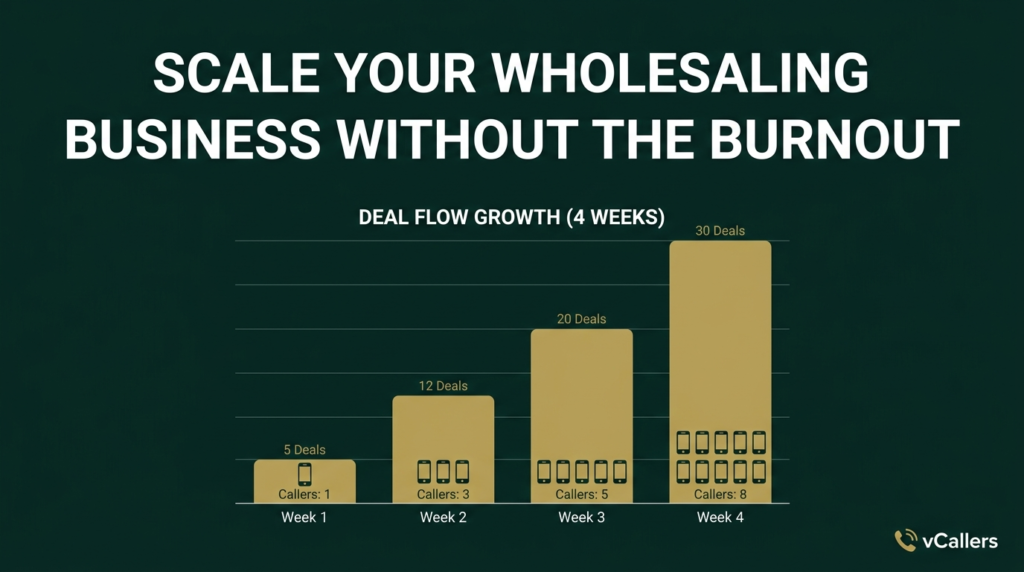
There’s a ceiling most real estate wholesalers hit somewhere between 1 and 3 deals per month — not because the market dried up or because their strategy stopped working, but because they ran out of hours.
Cold calling is the engine of a wholesaling operation. Every deal in the pipeline started with someone picking up the phone and connecting with a motivated seller. The problem is that dialing 150–200 numbers a day, handling objections, logging contacts, and running follow-up sequences is a full-time job by itself — and it competes directly with everything else an investor needs to do to actually close deals.
This guide is for wholesalers who are ready to break through that ceiling. We’ll walk through exactly how to build a scalable cold calling operation using virtual callers — what to outsource, how to structure your team, what metrics to track, and the common mistakes that keep investors stuck in the one-person bottleneck.
The pattern is almost universal. An investor gets their first taste of real traction — consistent cold calls, a working script, a couple of deals closed — and then tries to do more of the same. They dial more. They stay on the phone longer. They sacrifice evenings to follow up on warm leads.
For a while, it works. Deal flow grows. And then it plateaus, because there are only so many hours in the day.
The breaking point usually looks like one of three things:
The investors who scale past this plateau don’t suddenly find more time. They build a system that multiplies their output without multiplying their personal hours. That system almost always involves virtual cold callers.
|
200+
Dials per caller per day
|
5–12
Touchpoints to close a deal
|
3×
More deals with outsourced calling
|
There’s a common misconception that outsourcing cold calling means handing over control of your deal flow to a stranger overseas. That’s not what a professional virtual cold calling service does.
A trained virtual caller handles the top of your funnel: initial outreach, qualification, objection handling, and follow-up scheduling. They are not acquisition managers, and they don’t replace your judgment on deal decisions. Here’s a clear breakdown:
| Virtual Caller Handles | You Handle |
|---|---|
| Initial cold call on your list | Reviewing qualified lead sheets |
| Objection handling and rapport building | Offers and deal negotiation |
| Discovery questions and motivation scoring | Final property evaluation |
| Follow-up cadence (call 2, call 3, SMS) | Contracts and closing |
| Hot lead flagging and live transfer | Building investor buyer network |
| CRM logging after every call | Deal packaging and disposition |
Scaling with virtual callers isn’t just about hiring someone and pointing them at a list. It requires a small infrastructure of tools and processes that keeps everything organized and measurable.
Everything starts with data quality. The best caller in the world gets poor results from a stale, over-dialed list. For a scaled operation, you should be rotating across list types — pre-foreclosures, absentee owners, tax delinquents, probate — and refreshing data quarterly.
Without a CRM, a scaled cold calling operation becomes chaos within a week. Your virtual callers need a place to log every interaction, and you need visibility into where every lead stands. Purpose-built REI CRMs like REsimpli, Podio, or InvestorFuse handle this well.
Your CRM pipeline should have at minimum: New Lead, Contacted, Follow-Up Scheduled, Hot Lead, Offer Sent, Under Contract, Dead/Nurture. Callers log status after every call. You review hot leads daily.
Even the best virtual callers need a starting point. Before onboarding a calling team, build a document with your primary opener, 3–4 discovery questions, and responses to the six most common objections you encounter in your target market. Review and update this quarterly as you learn what’s working.
Manual dialing doesn’t scale. Power dialers and predictive dialers dramatically increase the number of live conversations per hour. Popular options in the REI space include:
Scaling requires visibility. Set up a weekly review rhythm with your virtual calling team that covers: total dials, contact rate (dials that reached a live person), conversation rate (contacts who engaged meaningfully), and hot lead rate (conversations that flagged a motivated seller). These four metrics tell you everything about where your funnel is healthy and where it needs work.
There are two ways to build a virtual cold calling operation. Each has trade-offs worth understanding before you commit.
Hiring independent VAs from platforms like Upwork or OnlineJobs.ph gives you direct control over who you work with and how they’re compensated. You’ll typically find callers at $4–$10/hour, which looks attractive on paper.
The reality: this approach trades cost savings for a significant management burden. Recruiting takes weeks. Training is your responsibility. Quality control, scheduling, and script enforcement all fall on you. For investors who already have a systems-oriented team member to manage this, it can work well. For solo investors or small teams, it often creates the exact bottleneck it was meant to solve.
A professional cold calling service like vCallers provides trained callers, management oversight, TCPA-compliant dialing, and daily reporting as a fully managed service. You send your list, approve your script, and receive daily hot lead reports. The service handles everything in between.
The trade-off is cost — a managed service costs more per hour than an independent VA. But for most investors, the ROI calculation is straightforward: one extra deal per month from consistent, professional outreach more than covers the service fee.
| Hire Your Own VAs | Managed Service (vCallers) | |
|---|---|---|
| Setup time | 3–6 weeks | 48–72 hours |
| Management required | High (daily oversight) | Low (weekly review) |
| TCPA compliance | Your responsibility | Handled for you |
| Caller quality control | You manage | Built-in QA process |
| Scalability | Manual (hire more) | Add seats on demand |
| Best for | Investors with ops support | Solo investors and growing teams |
Investors who set realistic expectations about cold calling timelines perform significantly better than those who expect instant results. Here’s a realistic 30-day ramp-up for a new virtual calling engagement:
Your caller gets up to speed on your list, your script, and your target market. Expect lower dial counts and higher error rates during this window. This is normal. Use it as a listening period — review call recordings, identify where the script needs tuning, and give your caller feedback.
By week 2, an experienced virtual caller hits their stride: consistent dial volume, cleaner objection handling, and better note-taking after each call. You should start seeing qualified callbacks appearing in your pipeline. Don’t evaluate results here yet — the pipeline is still building.
This is typically when motivated sellers start surfacing in meaningful numbers. A well-run operation should produce 5–15 hot lead conversations per month from a single dedicated caller making 150+ dials per day. Some markets run hotter; some require more dials to surface the same volume.
Review your week 3 data: contact rate, hot lead rate, and which list segments are producing. Double down on what’s working. Retire underperforming list segments. If results are strong, this is the moment to add a second caller or expand into an adjacent market.
Once you have a single caller producing consistent results — a reliable hot lead rate, a follow-up system that’s working, and enough deal flow to keep your acquisition pipeline full — scaling is a matter of replication.
Here’s what the path looks like for most investors:
At 3–4 dedicated callers across two markets, a well-run wholesaling operation can realistically sustain 8–15 deals per month. That’s not a ceiling — it’s where most investors find the sweet spot between growth and manageability.
Tracking raw dial counts makes investors feel productive. Tracking the right metrics makes them more profitable. Here are the four numbers that tell you whether your virtual calling operation is healthy:
Scaling a real estate wholesaling business isn’t about working harder. It’s about building a system that works while you do the things only you can do: evaluate deals, negotiate with sellers, and build your buyer network.
Virtual cold callers are the leverage point that makes this possible. When you have the right list, the right script, and the right team dialing consistently on your behalf, your pipeline stops being a function of how many hours you personally put in — and starts being a function of how well your system is built.
That’s the difference between a wholesaler who closes 2 deals a month and one who closes 10.